OSCARS at the EUDAT Conference 2026
Calendar Event date
26 November 2026
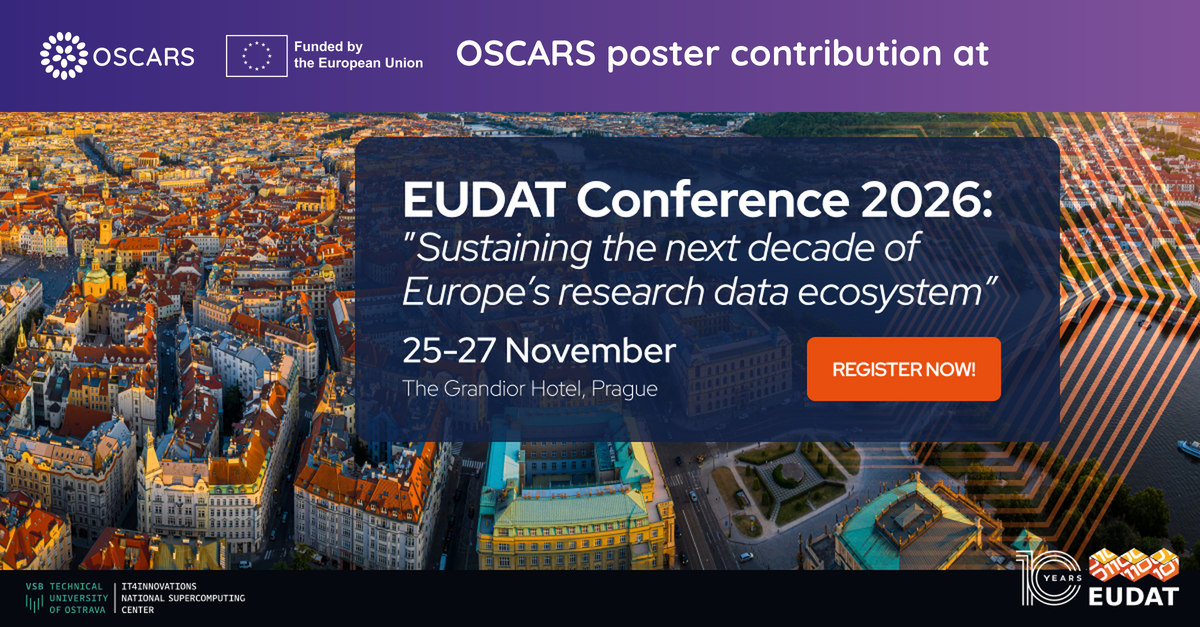
On 25-27 November 2026, OSCARS will be at the EUDAT Conference 2026 in Prague with the poster “OSCARS funded projects: key figures”, proposed by OSCARS WP3 lead and ENVRI Science Cluster representative, Anca Hienola (FMI). The poster is part of the session EUDAT Services in Community Data Workflows chaired by Debora Testi (CINECA, EUDAT Secretariat), and taking place on 26 November 2026 at 16:30 in the Ceremony room.
The conference theme is “Sustaining the next decade of Europe’s research data ecosystem”, and this edition marks EUDAT’s 10 years of operation.
Funding Open Science projects is an important step towards building a European research data ecosystem. But funding innovation does not automatically deliver interoperability, sustained service provision, or long-term scientific reuse.
Through two competitive Open Calls, OSCARS has allocated €16.5 million to 70 Open Science projects across the five EOSC Science Clusters (ENVRI, ESCAPE, LS-RI, PaNOSC and SSHOC) and beyond. Together, these projects address challenges in research data repositories, metadata annotation, software and AI tools, and the adoption of Open Science practices.
The poster gives a portfolio-level overview of the funded projects: their disciplinary distribution, their contributions across the research data lifecycle, their emerging outputs and their capacity-building activities. Current monitoring records 434 outputs, 349 of them with associated links. The lifecycle mapping shows uneven coverage: 41 projects contribute to data sharing, 26 to reuse, and only 12 to preservation.
These findings raise a fundamental question: are we building a sustainable ecosystem of interoperable services, or simply producing another generation of project-funded outputs?
The poster invites discussion on what is needed to turn promising project results into discoverable, reusable, maintainable and interoperable services. It also asks how funding programmes and service providers can work together so that Open Science investments generate value beyond individual project lifetimes, including through established research data infrastructures such as EUDAT and the evolving EOSC Federation.
Session details: EUDAT Services in Community Data Workflows
Full programme: EUDAT Conference 2026