
InViMOD - Intelligent Visualisation of Multimodal Operando Data for Energy Systems: A FAIR Workflow
Science cluster & challenges


Summary
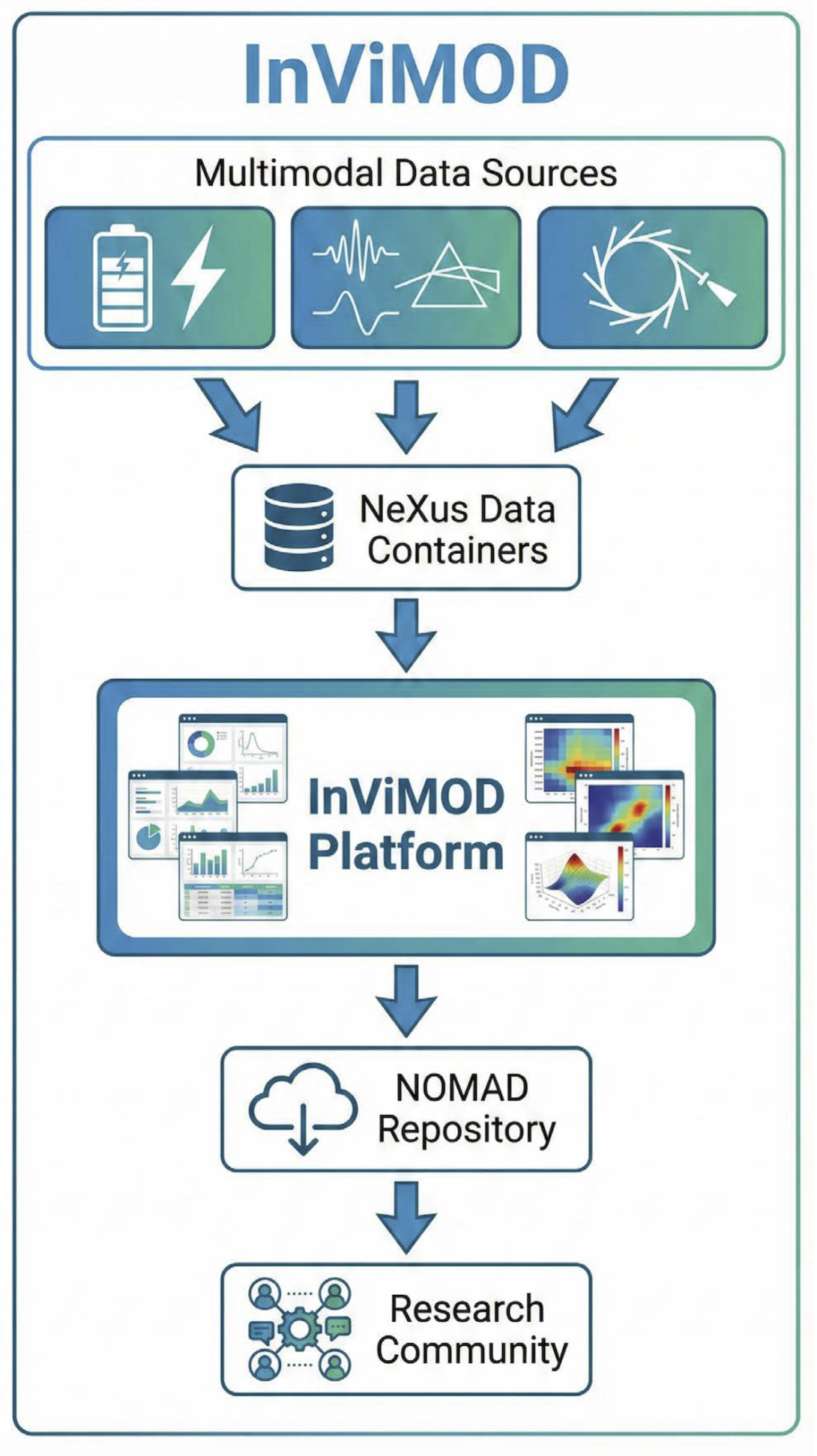
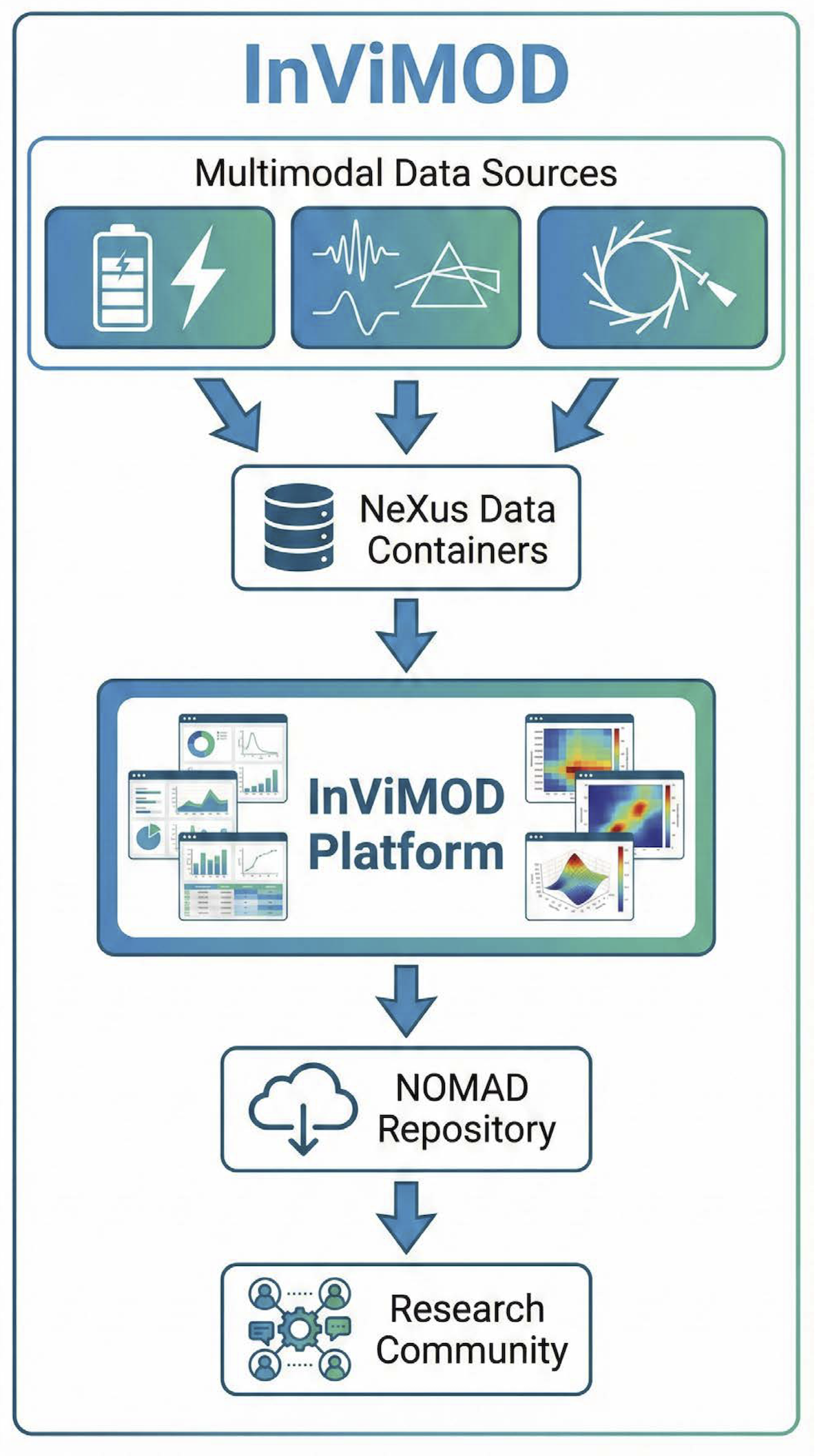
InViMOD will develop an open, modular platform for exploring, synchronising, and analysing complex multimodal datasets generated by operando experiments in advanced battery research and materials science. It will do so by providing a unified, interoperable digital workflow to merge and visualise heterogeneous time-resolved data streams generated with techniques spanning X-ray imaging, absorption spectroscopy, Raman spectroscopy, UV-Vis spectroscopy, electrochemical impedance spectroscopy (EIS), and cycling data.
Challenge
Many of Europe’s leading research infrastructures (RIs) and laboratories produce vast volumes of real-time experimental data. However, these data are fragmented across formats, instruments, and disciplines, preventing their full reuse and joint interpretation.
Solution
InViMOD will provide an open-source, FAIR-compliant platform for collecting, aligning, visualising, and analysing heterogeneous operando datasets. As an initial demonstrator, the project will use lithium-sulfur (Li–S) batteries, which promise high energy density but present complex degradation pathways involving polysulfide shuttle effects and unstable interfaces. The InViMOD platform will allow scientists to correlate chemical, structural, and electrochemical changes in real time.
Developed through a collaboration between Helmholtz-Zentrum Berlin and Batalyse GmbH, the platform will adopt the NeXus data format, and integrate tightly into NOMAD Oasis, a FAIR-aligned materials data repository. Fully open-source, it will be released under a permissive licence on GitHub.
Three real-world demonstrator use cases will validate InViMOD:
- Synchrotron Imaging at BESSY II (BAMline): time-resolved correlation of X-ray imaging with electrochemical data.
- Synchrotron Spectroscopy at BESSY II: combined X-ray absorption spectroscopy (XAS), impedance, and cycling data.
- Lab-based Multimodal Experiments: correlation of Raman, UV-Vis and impedance spectroscopy, temperature, and operando battery test data.
Scientific Impact
InViMOD’s software architecture is designed to be chemistry-agnostic and applicable to emerging systems, such as sodium-ion, lithium-metal, and solid-state batteries, as well as to broader domains including electrocatalysis, corrosion, and thin film materials research.
Furthermore, extensive multilingual dissemination material - including tutorials, example datasets, Jupyter notebooks, and recorded webinars - will be provided, while a dedicated ambassador programme and co-design workshops will empower community co-development and accelerate user adoption across Europe and beyond.
InViMOD will also actively onboard reusable APIs, metadata schemas, and workflows into the EOSC and will contribute to interoperability efforts within FAIRmat, NOMAD, DAPHNE4NFDI, and PaNOSC, as well as to Europe’s Green Deal, energy transition strategies, and sustainable innovation goals.
Principal investigator

Oliver Löhmann studied chemistry at the Technical University Berlin. After his PhD in Berlin and Darmstadt in the field of soft matter, he worked on the test-beamline of the European Spallation Source at the experimental reactor BER II. Here, he tested new instrumentation and data pipelines for future beamlines. Afterwards, Oliver had a Postdoc position at the German Federal Institute for Materials Research and Testing, mainly focusing on nanoparticle analysis. Since 2023, he has worked at the Helmholtz Zentrum Berlin. His main topics are multi-modal operando analysis of batteries, data handling, and data analysis.