OSCARS goes beyond funding and organising Open Call initiatives. It also drives progress in Competence Centres (WP1), Service Composability (WP2), and Community Uptake (WP3). Within Work Package 2, the Photon and Neutron Open Science Cluster (PaNOSC) is leading efforts to
- Establish persistent identifiers (PIDs) for scientific instruments.
- Strengthen the ontology of Photon and Neutron Experimental Techniques (PaNET).
- Standardise the Direct DOI Data Access (D3A).
We decided to follow the pioneers (ISIS neutron source and BESSY II synchrotron) by focusing on the PIDINST schema.
Why PIDINST matters
PIDINST enables the assignment PIDs via DataCite or B2INST, ensuring instruments are findable and interoperable. Although the main application of PIDINST are simple instruments like dataloggers, also complex setups like synchrotron and neutron beamlines can also be described. To date:
- 4593 instruments are registered using PIDINST.
- One-third of these are hosted on DataCite.
- 27 beamlines across four facilities worldwide are already described.
By adopting PIDINST, research infrastructures gain:
- Traceability: Clearly link experimental data to its source instrument.
- Enhanced Discovery: Improve visibility of beamline-specific metadata.
- Knowledge Graph Integration: Embed beamlines as first-class entities in scholarly networks.
- Consistency & Accessibility: Provide standardised descriptions, centralise information, and simplify updates for beamline catalogs.
Addressing Complexity: Challenges with Beamline PIDs
In contrast to simple instruments like dataloggers, beamlines are very complex and evolve over time. This imposes unique challenges:
- Landing Page Stability: URLs may change, requiring manual updates.
- Temporal Accuracy: Capturing an instrument’s evolution demands versioned descriptions with dedicated landing pages.
Since the launch of OSCARS, we’ve explored solutions to these issues. And now we are ready to scale them.
Building a Collaborative Framework
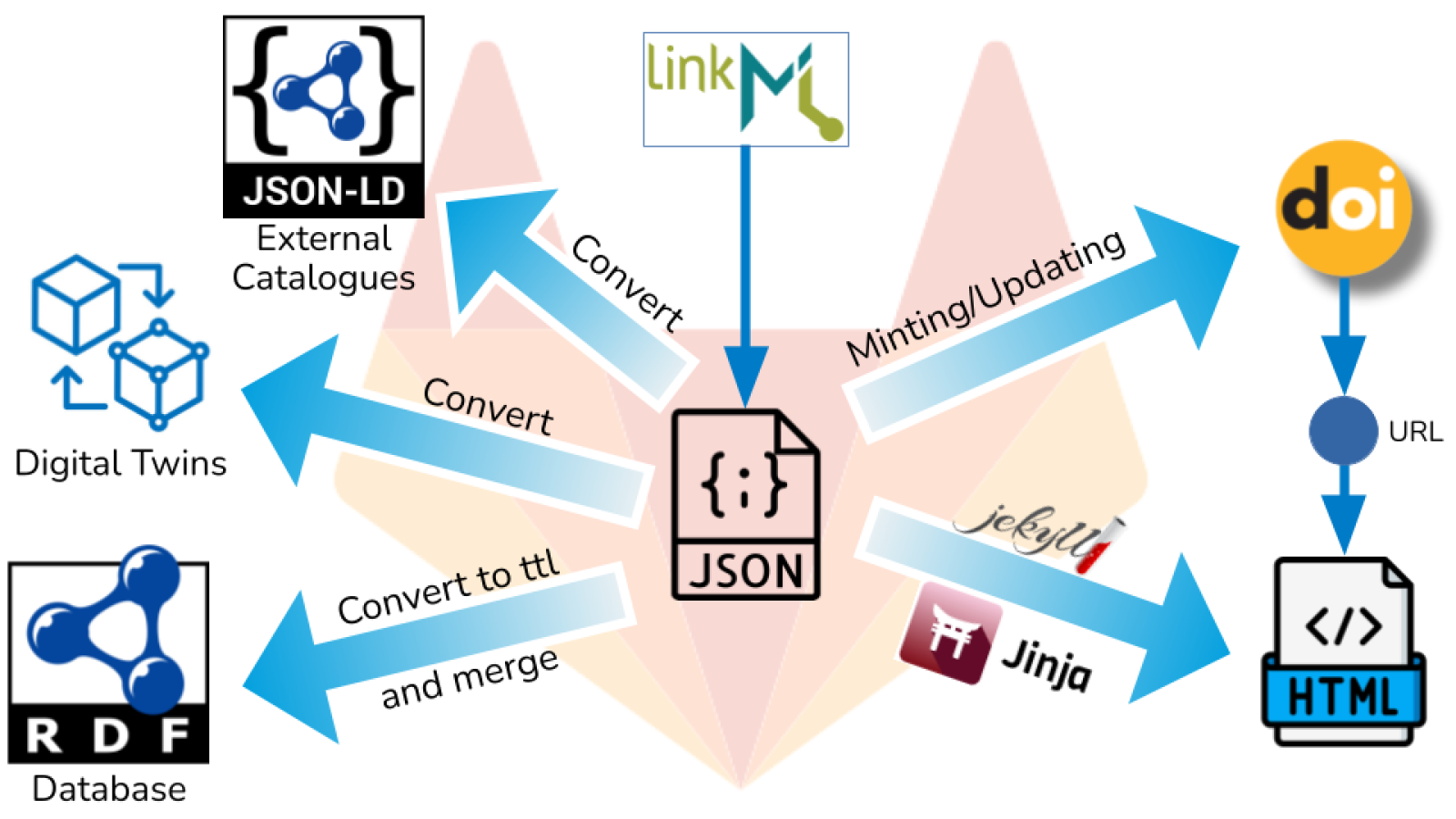
Our proposed workflow leverages Git repositories and automated pipelines to streamline PID management:
- Structured Data Collection
- Store experimental and technical metadata in JSON datasheets within a Git repo.
- Enable collaborative editing, version control, and transparency.
- Dynamic Landing Pages & DOI Minting
- Use tools like Jekyll or or Jinja to generate template-based HTML landing pages from JSON.
- Automate DOI registration and updates (via DataCite/B2INST) with the HTML page as the landing target.
Advanced Querying & Interoperability
- Convert and merge JSON files into an RDF database for public SPARQL queries.
- Create custom services (e.g., Beamline Finder for DESY) and integrate with external catalogues (WayForLight, Helmholtz Imaging Connect).
Support Digital Twin applications (e.g., simulations via xrt, oasys, and McStas) by embedding additional machine-readable files
Community Engagement: From Webinar to Workshop
On June 18 2026, we hosted a 1.5-hour webinar to introduce our vision to 25 participants from over 10 PaN facilities and European organisations. The response was overwhelmingly positive:
Near-unanimous interest in joining the initiative.
Next Steps: Planning an in-person/hybrid workshop to dive deeper into implementation strategies.
Join Us!
The adoption of PIDINST isn’t just about standardisation, it’s about unlocking new possibilities for data reuse, collaboration, and discovery in the photon and neutron communities – and beyond.
Interested? Subscribe to our Mailing List:
- Go to the subscription page, add your details, and confirm by pressing the blue button. Confirm on the next page.
- Check your emails and follow the link provided in the mail by SYMPA. Confirm again.
Stay tuned for workshop announcements and pilot opportunities.
Let’s build the future of instrument identification together.