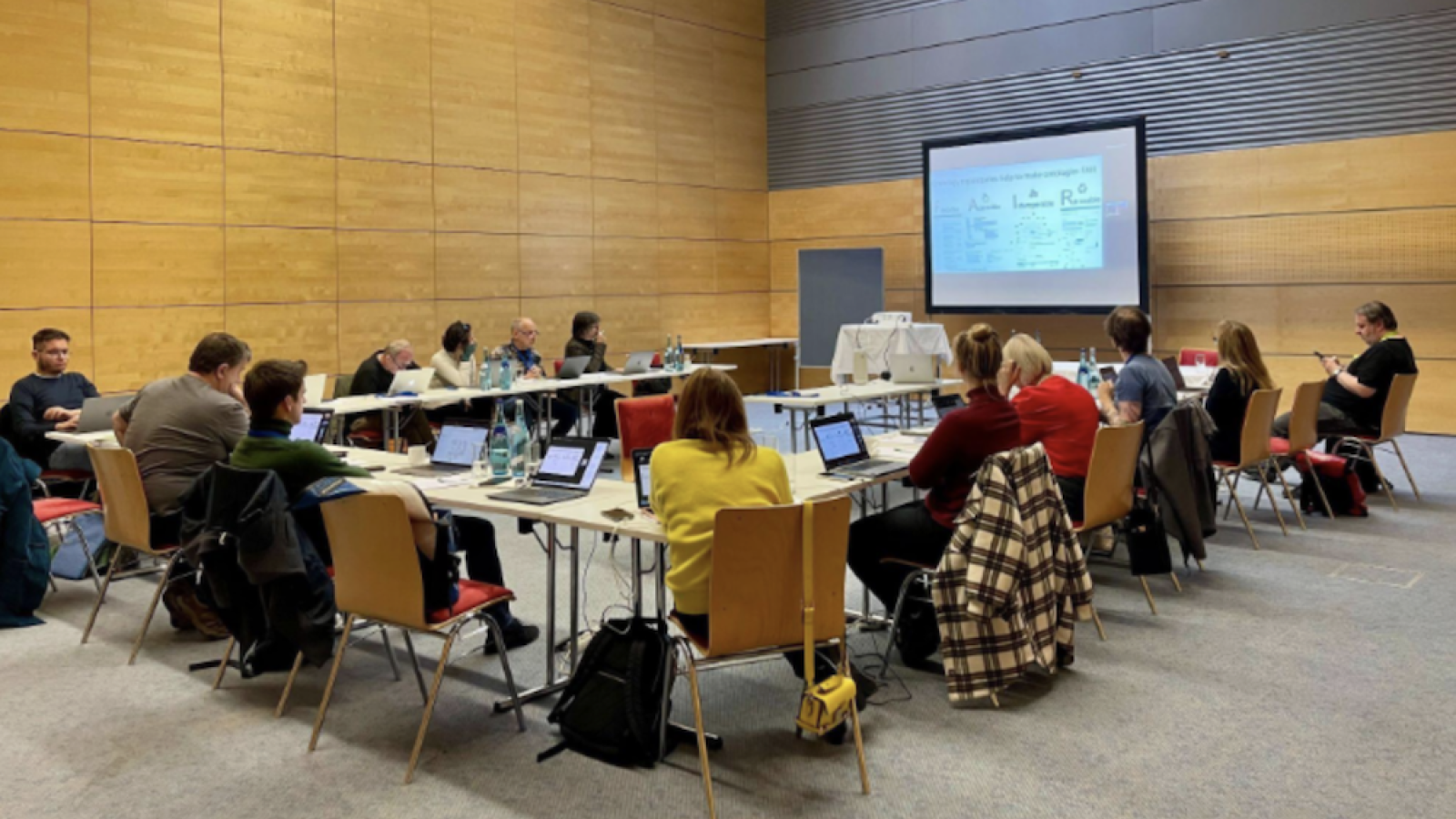
The OSCARS Task Force on EOSC Glossaries organised a hybrid workshop on October 2nd, 2025, as a satellite event of the CLARIN2025 conference, held in Vienna. The event aimed to share experiences and discuss ongoing efforts to enhance the findability and interoperability of semantic artefacts available within the five Science Clusters in the EOSC ecosystem, based on an inventory of current solutions and community requirements. The workshop gathered about 20 experts from ENVRI, ESCAPE, LS-RI, PaNOSC, SSHOC, and various vocabulary solution providers.
After sharing and discussing cluster-specific practices in vocabulary usage, several key systems were highlighted as solution providers, including OntoPortal (used by BioPortal, AgroPortal, CESSDA, etc.), the BARTOC terminology catalogue, and the FAIRsharing registry, all of which aim to make semantic artefacts discoverable and reusable across disciplines.
Also, a few community solutions were explained, e.g., NVS for the environmental sciences.
Additionally, summary reports of RDA activities relevant for the topic of the workshop were presented. A major focus of the discussion was the harmonisation of vocabulary metadata and ways to search in vocabulary metadata and content, and ultimately to facilitate federated search and sharing of vocabularies across the science clusters. The discussion often referenced the Metadata for Ontology Description (MOD) and the MOD-API.
The workshop concluded with a roadmap for potential actions for cluster representatives, aimed at harmonising and improving the findability of selected relevant semantic artefacts in their domain and cross-domain initiatives. The roadmap includes investigating the possibility of establishing an ‘EOSC Semantic Node’: a node for vocabulary discovery and management within the EOSC nodes ecosystem. The workshop participants also agreed to collaborate on a vision document, identify pilot projects for implementation, and explore the capabilities of AI in analysing semantic overlap between existing vocabularies.
Read the full report