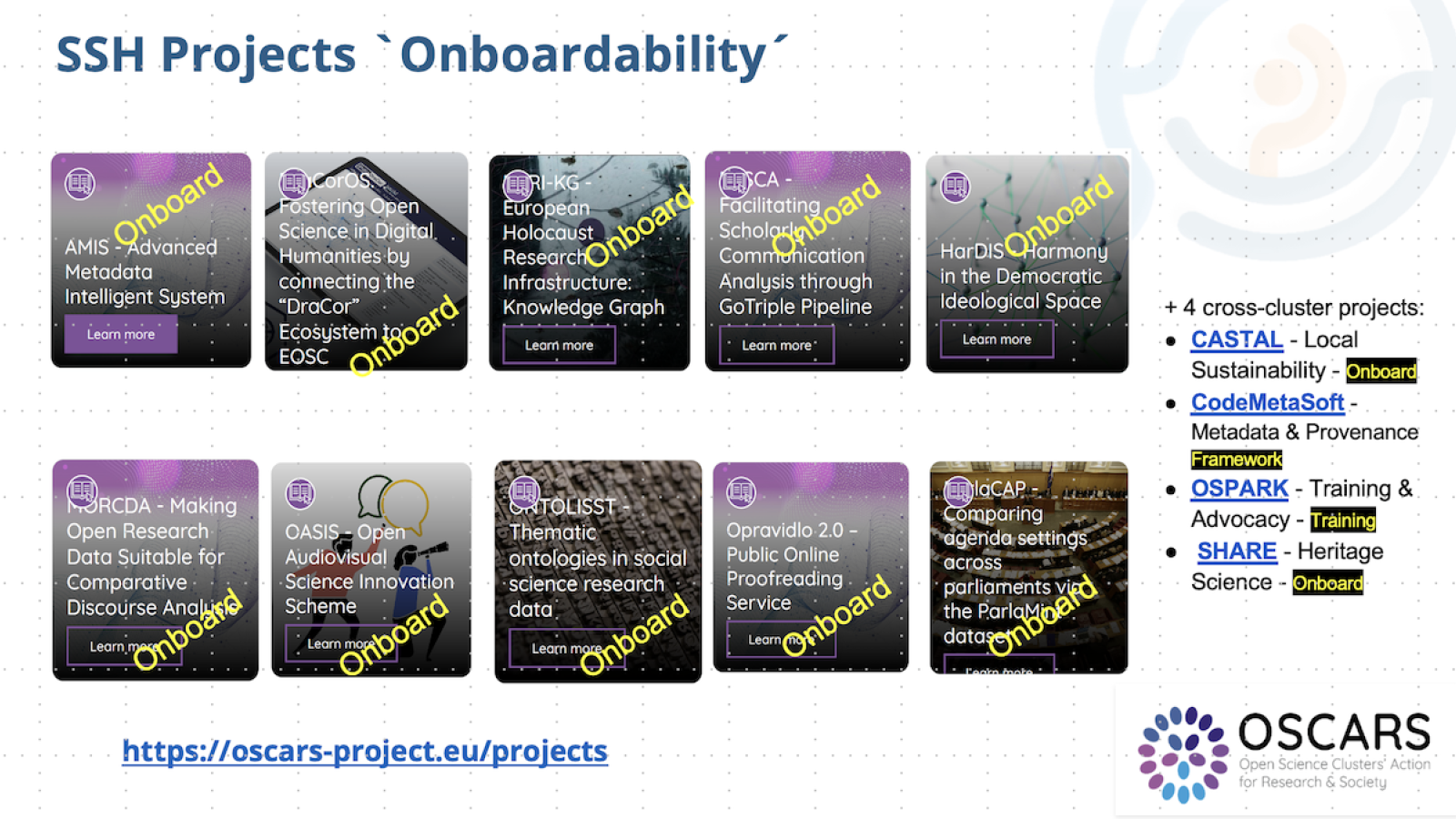
At the OSCARS and EOSC Association webinar on “EOSC Federation and the Science Cluster EOSC Nodes & Hubs: Onboarding of Services” held on 17th February, Bonnie Wolff-Boenisch presented the SSHOC cluster and its evolving role within the EOSC Federation, representing the social sciences, humanities and arts landscape.
The SSHOC cluster brings together a diverse group of research infrastructures, including CLARIN, DARIAH, OPERAS, CESSDA, the European Social Survey (ESS), as well as E-RIHS and EHRI alongside newer infrastructures that plan to associate soon. Many ERICs/RIs in SSHOC are EOSC members and active contributors to working groups. Since 2022, a Memorandum of Understanding has strengthened alignment among the ERICs and associated partners, with a shared focus on interoperability and coordination.
A central instrument for integration is the SSHOC Marketplace, a service catalogue that previously interfaced with the EOSC catalogue and is now being further aligned for further interoperability and future federation integration. SSHOC has been highly engaged in OSCARS, with significant participation across calls, reflecting both the heterogeneity and fragmentation of the social sciences and humanities domain. Projects span a wide range of disciplines and data types - from language resources and survey data to audiovisual materials and sensitive social data - highlighting the methodological diversity and interoperability challenges of the SSH landscape.
Encouragingly, all OSCARS-funded SSH projects show strong potential for onboarding, either through their “mother” research infrastructures, via the SSHOC Marketplace, or directly into EOSC. The SSHOC Competence Centre is being strengthened to act as a one-stop support mechanism for research communities, while strategic efforts focus on greater alignment and interoperability across infrastructures, convergence of standards, and coordination of virtual research environments.
Rather than establishing a single unified SSH node, the current strategy prioritises distributed development. CLARIN and DARIAH are involved in the EOSC Mesh project towards an SSH-oriented node, with a special focus on governance aspects; OPERAS focuses on scholarly communication and partnerships such as OpenAIRE; and CESSDA is a piloting node in EOSC Beyond, having a technical focus in testing integration with the pre-production EOSC environment, which is crucial for integrating, testing and validating solutions developed among national, regional and thematic infrastructures.
The most likely scenario is that a few separate thematic nodes will emerge in 2027-2029 under the SSHOC label with multiple pathways (nodes). This differentiated approach reflects the breadth of the SSH domain and aims to build sustainable pathways for onboarding tools and services, including disciplines not yet represented by dedicated SSHOC research infrastructures, such as , among others, economics, psychology, law and migration.
Through strategic alignment, marketplace integration, and coordinated onboarding pathways, SSHOC continues to shape how SSH services can be sustainably integrated within the evolving EOSC Federation.
If your project develops services in the social sciences and humanities, get in touch with the SSHOC Competence Centre to identify a clear route from results to long-term impact.