Persistent Identifiers are connecting the Web of Research that enables FAIR and Open Science.
OSCARS has published a new practical article, "Build your PID strategy: A practical introduction for research projects," authored by a cross-cluster team from ERINHA, DESY, CERIC-ERIC, KNAW-DANS, BBMRI-ERIC, DARIAH, E-RIHS ERIC, the University of Vienna, Trust-IT and CNRS-LAPP.
Why PIDs matter
As research becomes increasingly digital, distributed and collaborative, research outputs - publications, datasets, software, workflows, samples, instruments, organisations and researchers - are too often identified through inconsistent local identifiers or unstable URLs. This fragmentation limits discovery, attribution and the implementation of the FAIR principles. The UNESCO Recommendation on Open Science identifies PIDs as a key enabling component of Open Science infrastructures and this article shows how to put that principle into practice.
Complementary, not competing
There is a common misconception that a single PID system could cover every research entity. In reality, different entities require different identifier systems - ORCID for researchers, ROR for organisations, DOI for publications and datasets, RAiD for projects, PIDINST for instruments, IGSN for samples, and SWHIDs for software. Rather than competing, these systems work together to build an interoperable "PID Graph" connecting people, organisations, projects, publications, datasets, software and other research outputs.
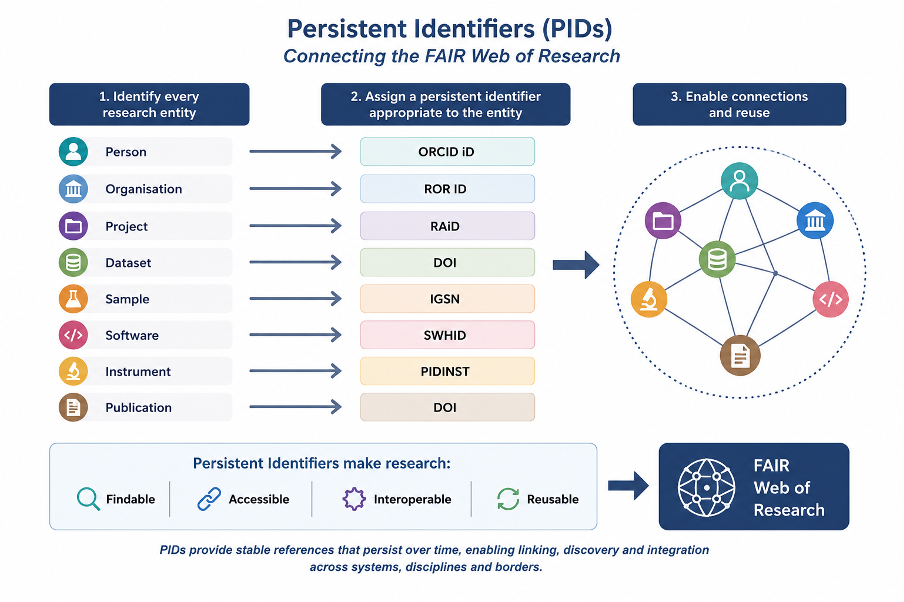
Five practical recommendations can help projects to develop a coherent PID strategy:
- Identify every relevant research entity from the outset;
- Plan your PID strategy from the beginning (in Data Management Plans, not as an afterthought);
- Reuse community-recognised PID systems rather than inventing project-specific ones;
- Prioritise rich, machine-actionable metadata, not just the identifier itself;
- Capture relationships between entities throughout the research lifecycle to build genuine interoperability.
Choosing the right PID isn't about popularity. The article sets out six criteria to select the most appropriate one in any specific case - fit for the entity, sustainable governance, rich metadata, ability to capture relationships, interoperability with existing infrastructures, and community adoption - alongside a step-by-step view of common implementation pitfalls (missing entities, unnecessary new identifiers, late assignment) and how to avoid them.
Key takeaway
Persistent identification isn't achieved simply by assigning an identifier. It depends on well-governed services, rich metadata, and explicit relationships between research entities.
The article closes with a curated selection of community resources to support implementation, from the DoRANum PID Summary Sheet as a starting point, to the EOSC PID Policy, FAIR-IMPACT guidelines, FAIRsharing, RDMkit, and ecosystem tools like DataCite Commons and the PID Forum.
Read the full article on Zenodo and start shaping your project's PID strategy.