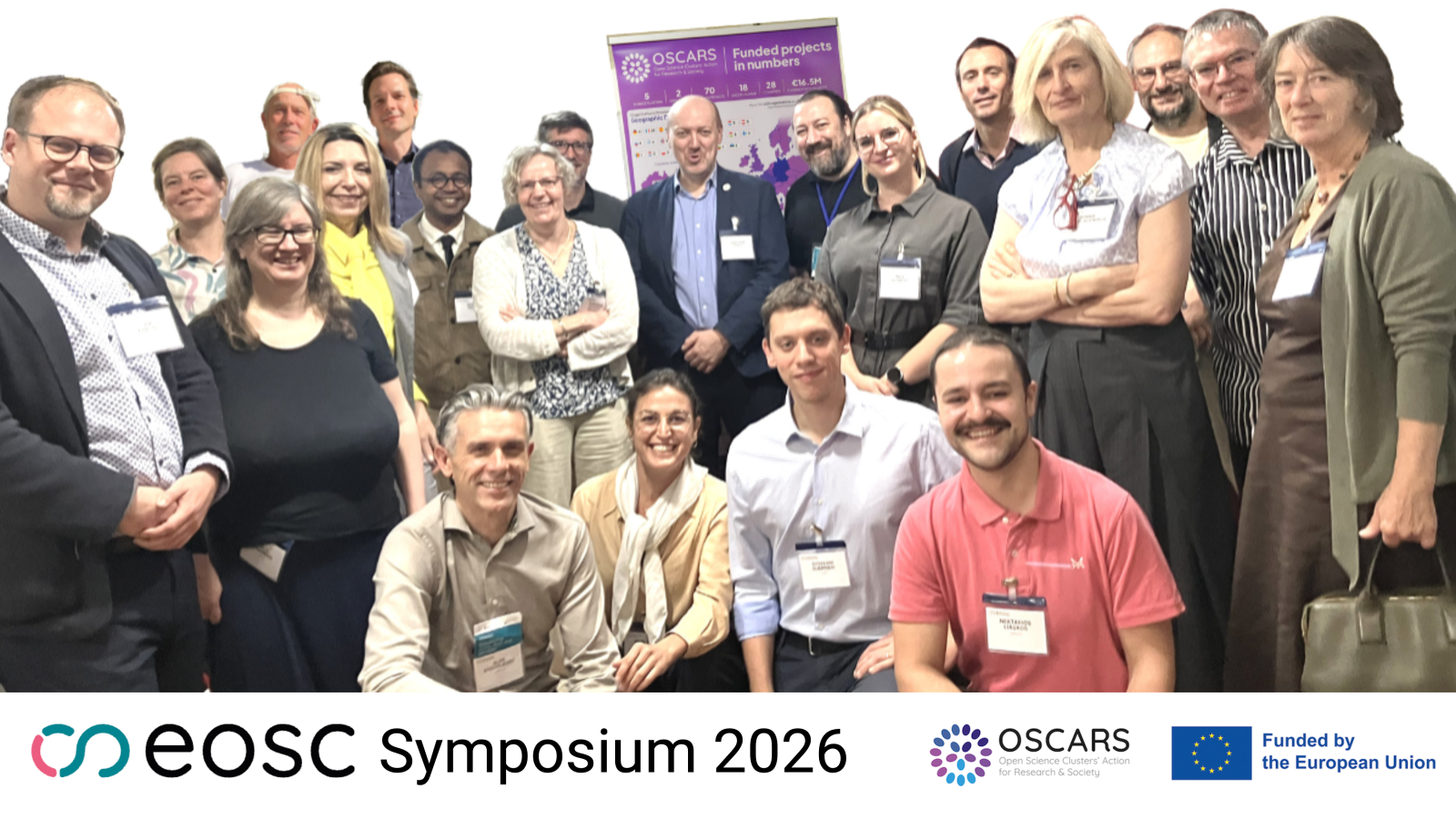
From AI-ready data to sensitive collections and training, OSCARS-funded projects and Science Cluster representatives brought concrete experience to the EOSC Symposium 2026.
More than 500 participants from 35 countries gathered in Florence on 14–16 October for the EOSC Symposium 2026, days after the EOSC Federation entered production. OSCARS took part with a booth shared with its sister project EVERSE, presenting the 70 projects funded through the two OSCARS Open Calls for Open Science projects and services. Representatives of the funded projects and of the Science Clusters also contributed to sessions across the programme. Looking back, four topics kept coming up.
AI depends on well-described data, not only on computing power
For the photon and neutron community, data volume is the defining challenge: facilities generate petabytes of raw experimental data every year, and AI-based methods have become a prerequisite for analysing them. Yet “the limiting factor is not compute capacity, but the ability to exploit the data,” noted Oliver Knodel (HZDR), contributor to the OSCARS-funded project mTeSS-X, presenting the EOSC Node of the PaNOSC Science Cluster in the session on capacity building for AI. The node pairs curated FAIR datasets prepared for AI use with training embedded in the research ecosystem, including the PaN-Training catalogue built on TeSSHub.
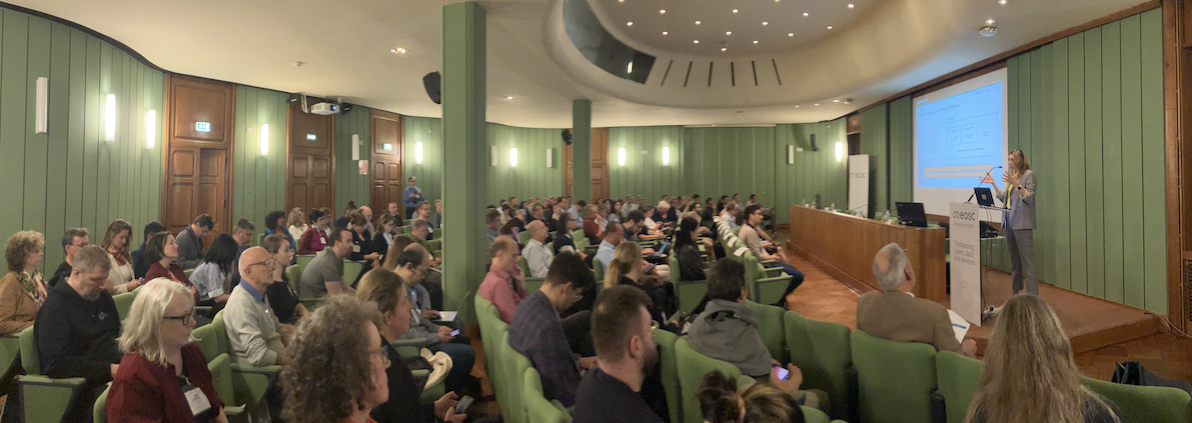
The session on automating data FAIRification approached the same question from the side of data production. Anca Hienola (FMI, ENVRI Science Cluster) argued that “FAIRification at scale starts at the source”: rather than one central platform making everything FAIR, scientific responsibility remains with the research infrastructure that produces the data, and “the metadata burden is handled by infrastructure - not transferred to each researcher.” AI can help extract candidate metadata, suggest vocabulary mappings and flag missing fields, but it cannot recover missing provenance or the scientific meaning of an unknown variable: “Without provenance, AI produces confident metadata, not FAIR data.”
Sylvia Le Dévédec (Universiteit Leiden), PI of the OSCARS-funded project BIO-CODES – among the first projects that reached completion - took the discussion to the laboratory bench. Following a bioimaging experiment from screen design to phenotypic profile, she showed that “humans are still heavily needed mainly where the biology is described and interpreted.” She described FAIR by design as “automation moved upstream”, complementing ex-post FAIRification. BIO-CODES contributes content-based identifiers (ISCC, ISO 24138), derived from the data itself and designed to be generated automatically at the point of acquisition; the identifier work delivered a design and proof of concept, with a beta integration in OMERO.
Franciska de Jong (CLARIN ERIC, SSHOC Science Cluster) brought the perspective of the social sciences and humanities, where data is diverse along multiple dimensions: region, modality, period and context. CLARIN, a federation of data repositories since 2012, was “FAIR avant la lettre”. Interoperable metadata, she noted, can be generated through human curation and through automated extraction, such as language identification, named entity recognition and stylometry, a share that AI will increase. FAIR metadata can also be offered to machines to generate scientific knowledge graphs (SKGs), an outcome of the SSHOC pilot in the Horizon Europe project OSTrails.
FAIR does not always mean open
Some collections can never be fully open. ERIHAD.OS, funded through the second OSCARS Open Call and led from the Center for Research on Antisemitism (ZfA) at TU Berlin, works with collections where “the content itself is the hazard”, from antisemitic imagery to annotated hate comments. Shaped by 100 interviews with data holders, whose position was “No data transfer, BUT analysis & reuse welcome”, the project’s answer, presented by Jan Krasni, is compute-to-data: the researcher’s algorithm is brought into a trusted research environment where the data “never leaves its host”, and only “audited, privacy-checked results” come out. The ambition is “one sovereign compute-to-data pattern”, a reusable approach “for every collection that must be FAIR, and can never be open”. The team is now looking for an EOSC Node to build and test it with: “No data moves. Your rules, our control”.
No researcher, no node
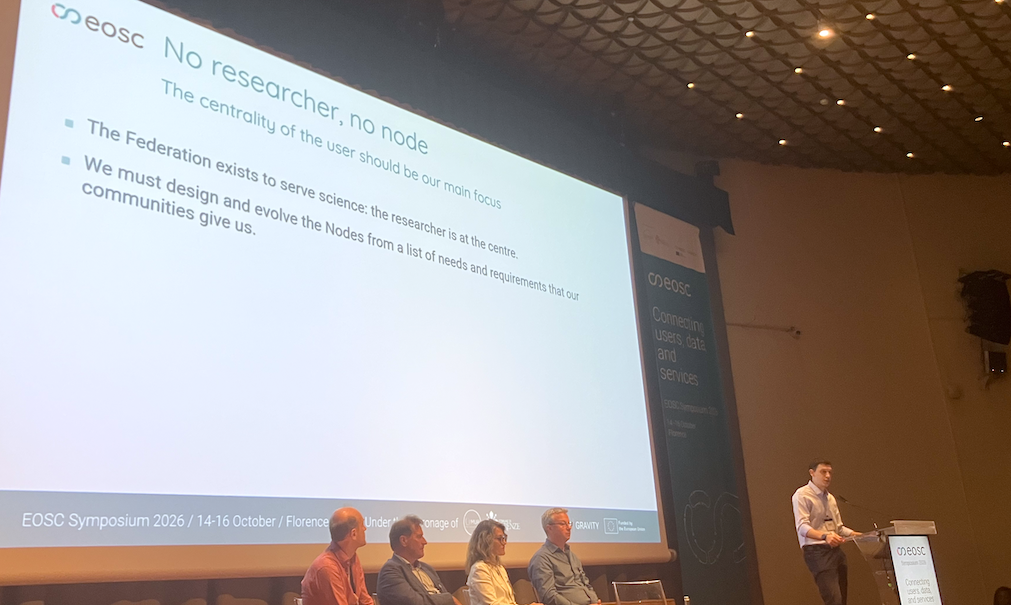
“The Federation exists to serve science: the researcher is at the centre,” stated Giovanni Guerrieri (CERN, ESCAPE Science Cluster) in his closing remarks to the session on the usage of EOSC Nodes, which he co-chaired with Jonathan Tedds (ELIXIR, LS-RI Science Cluster). Nodes, he added, must be designed and evolved from the needs and requirements of their communities. The gap is real: as an example, the researchers using Le Dévédec’s facility still have “no contact with EOSC today”.
Several OSCARS-funded projects are working to close it. Phil Reed (University of Manchester, mTeSS-X) presented TeSSHub4EOSC, built on the mTeSS-X platform: a single, interoperable access point for training resources now fragmented across EOSC, where EOSC Nodes and clusters can have their own “spaces”.
Marco Molinaro (INAF, Astro-CC), presenting the Astrophysics Astroparticle Space Sciences Thematic EOSC Node, named a shared language and interoperability as the challenge across these sub-domains, and discussed integrating the International Virtual Observatory Alliance’s registry of astronomy data and services into EOSC while keeping the richness of domain metadata.
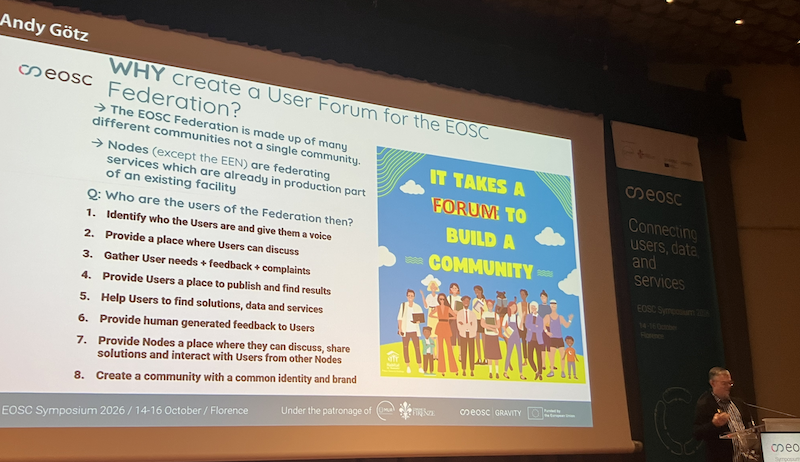
Researchers were also at the heart of the emerging EOSC Federation User Forum, chaired by Andy Götz (ESRF, PaNOSC Science Cluster) and Sally Chambers (DARIAH ERIC, SSHOC Science Cluster). Since the Federation “is made up of many different communities not a single community”, the forum aims to give users a voice and gather their needs and feedback.
In the same session, Stephen Serjeant (The Open University, Astro-DM TSP) presented citizen science in which human classifications provide training data for machine-learning models trained on EOSC Node compute.
Onboarding becomes concrete
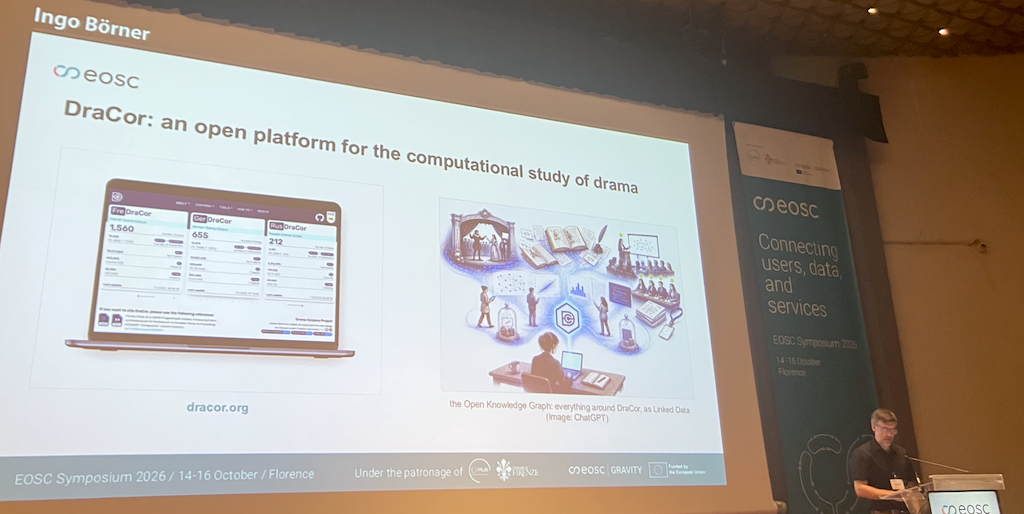
Finally, Ingo Börner (University of Potsdam, DraCorOS) gave a researcher’s perspective on onboarding the DraCor Open Knowledge Graph to the EOSC EU Node. What the project has deployed is a linked dataset of 116 million statements describing 4,902 plays from 24 corpora, offered through two public services: a public, read-only query service (SPARQL), and an MCP server through which AI tools can query the graph, with token-gated access. Everything is containerised, and the whole graph loads in about ten minutes.
Our thanks to all speakers, and to everyone who visited the OSCARS booth.