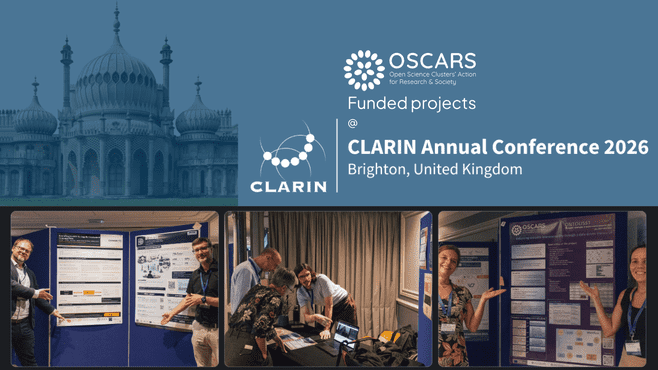
As part of CLARIN ERIC’s commitment to support the OSCARS cascading grant projects at all stages and to onboard their outcomes and communities, we were delighted to host four OSCARS cascading grant projects from the SSHOC cluster at the CLARIN Annual Conference 2026 in Brighton.
Anatole Grimaldi showed a live demo of the OASIS project which is developing an open-source transdisciplinary tool for the analysis, annotation, and long-term preservation of online video corpora called Celluloid. Celluloid enables researchers to analyse videos hosted on PeerTube by combining qualitative and quantitative analyses of audiovisual materials. It integrates manual annotation with artificial intelligence-assisted analysis, allowing users to perform shot-by-shot segmentation, automatic object detection, and speech-to-text transcription. The platform is intended for students and researchers from a wide range of disciplines, enabling them to explore how audiovisual annotation and AI-assisted analysis can support their research practices. As part of the OASIS project, we are also able to provide dedicated storage space on our PeerTube infrastructure, a federated video-sharing platform that provides an open and ethical alternative to commercial services such as YouTube, allowing researchers to securely host and manage the video corpora used in their research. By promoting digital sovereignty and reducing dependence on large technology companies, PeerTube contributes to the development of an open scientific infrastructure.
Ingo Börner presented the results of the DraCorOS project which is advancing the community-driven drama corpora platform DraCor by integrating its ecosystem with the European Open Science Cloud (EOSC) and promoting Open Science practices in Computational Literary Studies. He focused on two key deliverables of the project. The DraCor Textbook: A curated, pedagogically structured Open Educational Resource for learning how to work with programmable drama corpora. The Textbook is openly available under CC BY 4.0 and designed for use in teaching and self-study contexts across the DH research community. DraCor Open Knowledge Graph: A Linked Open Data resource modelling dramatic texts, metadata, computational tools, and scholarly publications building on the CIDOC-CRM ontology. Deployable to the EOSC EU Node via the Cloud Container Platform and openly accessible as a SPARQL endpoint, the knowledge graph serves as a showcase of how digital humanities projects can build on emerging shared EU research infrastructures. An MCP (Model Context Protocol) server further enables natural-language querying of the knowledge graph via LLMs, lowering the barrier to LOD access for non-technical users. Link to poster: here
Róza Vajda and Júlia Egyed-Gergely presented the ONTOLISST project, which aims to bridge the gaps between different social science ontologies for the semantic annotation of survey data. Their presentation outlined the main features of LiSST (Light Social Science Thesaurus) and described the stages and methods of its development. One specialty of this thesaurus is that it is data-driven, because its concepts originate in actual research data. Another important aspect is that it is founded on content metadata provided by selected archives, which helps in creating harmonized concepts, mappings, and crosswalks. Finally, in relying on (mainly for clustering and topic modelling) with frequent validation, ONTOLISST is by design an example of close human-machine interaction.
Jan Krasni presented the ERIHAD.OS project which bypasses the legal and ethical obstacles of sharing and reuse of sensitive datasets to study discrimination, hate speech and radicalization by inverting the standard data-sharing model to move computation to data instead of the other way around, allowing sensitive datasets to stay at their host institutions. Researchers submit analysis tasks (e.g. sentiment analysis, topic modeling, collocational queries) which execute locally at each node. Only anonymized, aggregated results return. They are in the early phase of building this infrastructure and visited CLARIN 2026 specifically to open a conversation and discussion. They were interested in four integration directions: 1) a metadata extension for legally constrained resources; 2) CLARIN registration; 3) a proposed backward-compatible Computational Query Mode for aggregated-results-only queries; 4) Language Resource Switchboard participation. They brought the domain expertise, legal framework, and data partnerships but were looking for CLARIN technical partners, and for anyone who has faced similar problems in their adjacent domains. Link to poster: here.
Picture captions:
Caption 1 (DSC08477-2.jpg): Róza Vajda and Júlia Egyed-Gergely with their ONTOLISST poster
Caption 2 (DSC08412-2.jpg): Anatole Grimaldi demoing the OASIS project
Caption 3 (DSC08485-2): Ingo Börner and Jan Krasni with their posters for DraCorOS and ERIHAD.OS