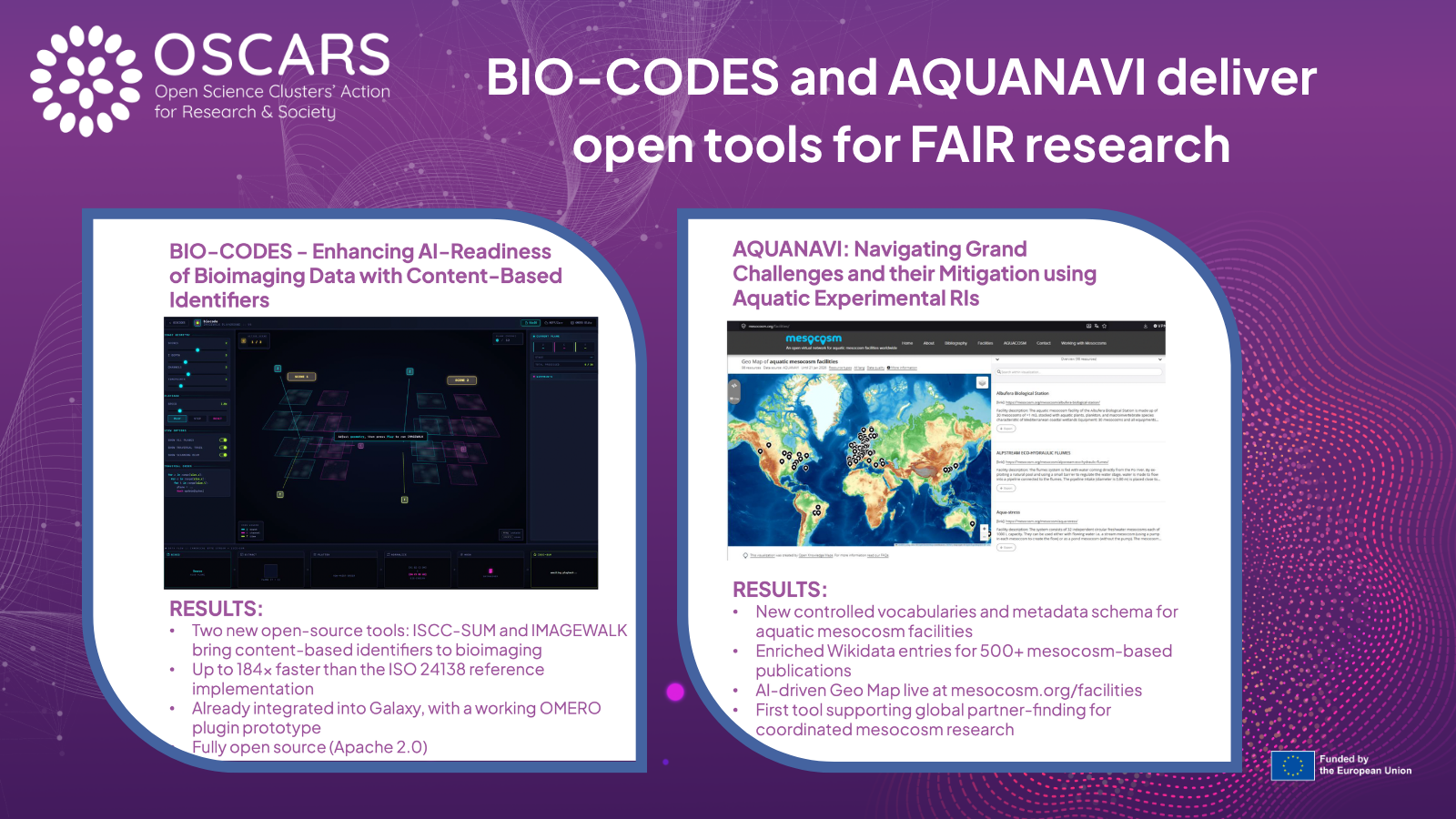
Two more OSCARS-funded projects have completed their work: BIO-CODES and AQUANAVI, adding to the growing portfolio of finished OSCARS results. BIO-CODES launched on 1st November 2024 and AQUANAVI on 1st December 2024; both ran for 18 months.
What the two share is a focus on making existing scientific effort - ISO-standardised content identification on one side, and decades of mesocosm-based aquatic research on the other - genuinely findable, verifiable, and reusable by the research communities that could benefit from each: bioimaging researchers building AI-ready datasets, and ecologists studying global change effects on aquatic ecosystems.
BIO-CODES: bringing AI-readiness to bioimaging data
Science Cluster: LS-RI
Bioimaging generates increasingly large, complex and heterogeneous datasets that challenge the FAIR principles - the idea that research data should be easy to find, access, combine with other data, and reuse. This challenge becomes more acute as AI-driven research increasingly depends on trustworthy, traceable training and validation data. Existing identifiers such as DOIs identify records, but they cannot verify whether the underlying data has changed, cannot detect duplicates, and cannot establish content provenance. This is a persistent gap for multi-gigabyte, multi-dimensional microscopy data spread across formats, operating systems and repositories.
The OSCARS-funded project BIO-CODES, led by Sylvia E. Le Dévédec at Leiden University (NL-BioImaging), in partnership with the ISCC Foundation, addressed this by applying the International Standard Content Code (ISCC - ISO 24138) to scientific bioimaging data. This standard generates similarity-aware codes directly from a file's actual content to support content-first metadata discovery, rather than an external assigned identifier based lookup. .
The team developed and integrated two complementary open-source tools:
- ISCC-SUM, a high-performance implementation of two algorithms of the ISCC standard. In a single read through the data, it produces two fingerprints: a similarity-preserving ‘Data-Code’, which answers the question ‘is this roughly the same data?’, and a cryptographic ‘Instance-Code’, which answers the question ‘is this byte-for-byte identical?’. Together, this enables both exact integrity verification and near-duplicate detection. Re-engineered in Rust, it reaches throughput above 1 GB/s and implements the TreeWalk specification, making directory-level fingerprints reproducible across operating systems, filesystems, cloud storage and archive formats. Therefore, identifying an entire folder of files gives the same result no matter which computer, cloud service, or archive format is used. It can be tried directly at sum.iscc.codes.
- IMAGEWALK (implemented in the iscc-bio tool) extends ISCC to this kind of multi-dimensional microscopy data. A microscopy image is often not just a single flat picture - it can include multiple depth layers (“stacks”), several colour channels, and snapshots taken over time and stored in different bioimaging file formats. Different software tools read through these layers in different orders, which breaks reproducibility: the same dataset can look different depending on what software reads it and if what format the image is stored. IMAGEWALK solves this by always reading, decoding and normalizing pixel-data in the same fixed order - stack, then channel, then time - regardless of the file format.. This also produces per-plane similarity fingerprints (“SIMPRINTs”), and works across both open and proprietary formats including OME-Zarr, CZI, ND2 and LIF.
Benchmarked against the ISO 24138 Python reference implementation, ISCC-SUM achieved up to 184× faster processing, sustaining roughly 950-1,120 MB/s - fast enough for routine use on multi-gigabyte scientific datasets. Reproducible identifier generation was also validated across data formats well beyond bioimaging, including Zarr, HDF5, NetCDF, DICOM, FASTQ, FITS and SEG-Y, pointing to potential adoption in genomics, astronomy, and geoscience.
The tools are already integrated into Galaxy, a widely used bioinformatics platform, with tools for ISCC generation, verification and duplicate detection now available. A functional prototype plugin also brings automated identifier generation to OMERO, a common microscopy data-management system, with conceptual integration pathways defined for the OME-XML and RO-Crate metadata standards. All software is open source under Apache 2.0, with public releases on GitHub, PyPI, crates.io and Zenodo, and a browser-based WebAssembly demonstrator is available in addition.
By making content verification, near-duplicate detection and provenance tracking reproducible and standards-based, BIO-CODES gives researchers a way to confirm dataset integrity independently of file names or storage location - usable today via Galaxy, and prospectively via OMERO.
- Code: github.com/bio-codes/iscc-sum | github.com/bio-codes/iscc-bio
- OMERO plugin: github.com/bio-codes/omero-iscc
- Try it: sum.iscc.codes
- Poster (2nd OSCARS AGM 2026): DOI 10.5281/zenodo.18914995
- Project webpage: https://oscars-project.eu/projects/bio-codes-enhancing-ai-readiness-bioimaging-data-content-based-identifiers | https://bio-codes.io/
- Final video: https://youtu.be/2KtE5msUhtU
AQUANAVI: navigating aquatic research infrastructure
Science Clusters: ENVRI, LSRI
Aquatic mesocosms - experimental units generally ranging from about 100 to 10,000 litres that mimic natural aquatic ecosystems under controlled, replicated conditions - allow researchers to study, e.g. how global change affects biodiversity and ecosystem function. Many of these experimental research infrastructures (RIs) in freshwater, brackish and marine systems have been built worldwide and used for ecosystem studies, and gathered by earlier EU-funded projects (MESOAQUA, AQUACOSM and AQUACOSM-plus led by Jens Nejstgaard and Stella Berger at the Leibniz Institute of Freshwater Ecology and Inland Fisheries (IGB) Berlin) establishing international networks around them, including the community platform www.mesocosm.org. Efforts to align common language and units for the formerly rather separated freshwater and marine research communities have been undertaken, however, it remained difficult to find the right mesocosm facility for a given research question: Technical information existed only as unstructured text with uncontrolled vocabulary, and publications reporting mesocosm experiments weren't systematically linked back to the facility where they were run.
The OSCARS-funded project AQUANAVI, led by Tina Heger at IGB Berlin and involving the non-profit organisation Open Knowledge Maps (OKMaps), set out to close that gap. The team's approach was to:
- Develop controlled vocabularies for three areas that previously lacked one: Grand Ecological Challenges (with definitions and persistent identifiers), broader research topics, and controlled parameters - the factors that can be manipulated within a mesocosm.
- Set up a semantic data model and metadata schema, putting the mesocosm installation itself as the core object linking facilities, publications and vocabularies.
- Consolidate and enrich metadata from www.mesocosm.org and aquacosm.eu, updating or creating Wikidata entries for more than 500 mesocosm-based publications.
- Built the OKMaps Geo Map, an AI-driven visual discovery tool now live under “Facilities” at mesocosm.org, letting users search and filter facilities by Grand Ecological Challenge, research topic, controlled parameter, location or equipment, so far for a subset of 100 facilities.
- Lay the groundwork for Knowledge Maps and Streamgraphs: publication metadata is now published in a standard machine-readable format, so it can be automatically collected by the Bielefeld Academic Search Engine (BASE), one of the world's largest search engines for academic research - a data source that will power these additional discovery tools once the pipeline is fully operational.
AQUANAVI's move to bring the wealth of data gathered by the AQUACOSM community into a sustainable, FAIR semantic environment (Wikidata, BASE, Open Knowledge Maps) was especially timely as aquacosm.eu, the project website that previously hosted much of this information, is no longer actively maintained. AQUANAVI makes the two decades of mesocosm-based research usable again. The team presented the work at the ASLO-SIL conference and the EGU General Assembly in 2026, and AQUANAVI is now part of the Hi Knowledge initiative (https://www.hi-knowledge.org), with plans to connect to the ENVRI HUB and EOSC services.
The Geo Map is, in the team's words, the first tool specifically supporting partner-finding for globally coordinated mesocosm experiments - capability the community needs to more efficiently study and mitigate the effects of Grand Ecological Challenges.
- Geo Map: mesocosm.org/facilities
- AQUANAVI collection (RIO journal): doi.org/10.3897/rio.coll.298
- Heger et al. 2025, Research Ideas and Outcomes: DOI 10.3897/rio.11.e176476
- Project webpages: https://oscars-project.eu/projects/aquanavi-navigating-grand-challenges-and-their-mitigation-using-aquatic-experimental-ris | https://aquanavi.hi-knowledge.org/
- Zenodo collections with Posters and Talks: https://zenodo.org/communities/aquanavi
From bioimaging to biodiversity: research made reusable
BIO-CODES and AQUANAVI show two different faces of the same underlying goal: making valuable scientific effort - whether newly generated bioimaging data or two decades of accumulated ecological research - genuinely findable, verifiable and reusable. In both cases, the results are open, standards-based tools and services that outlast the project itself.
Further details on each project can be found on the OSCARS website: oscars-project.eu/projects