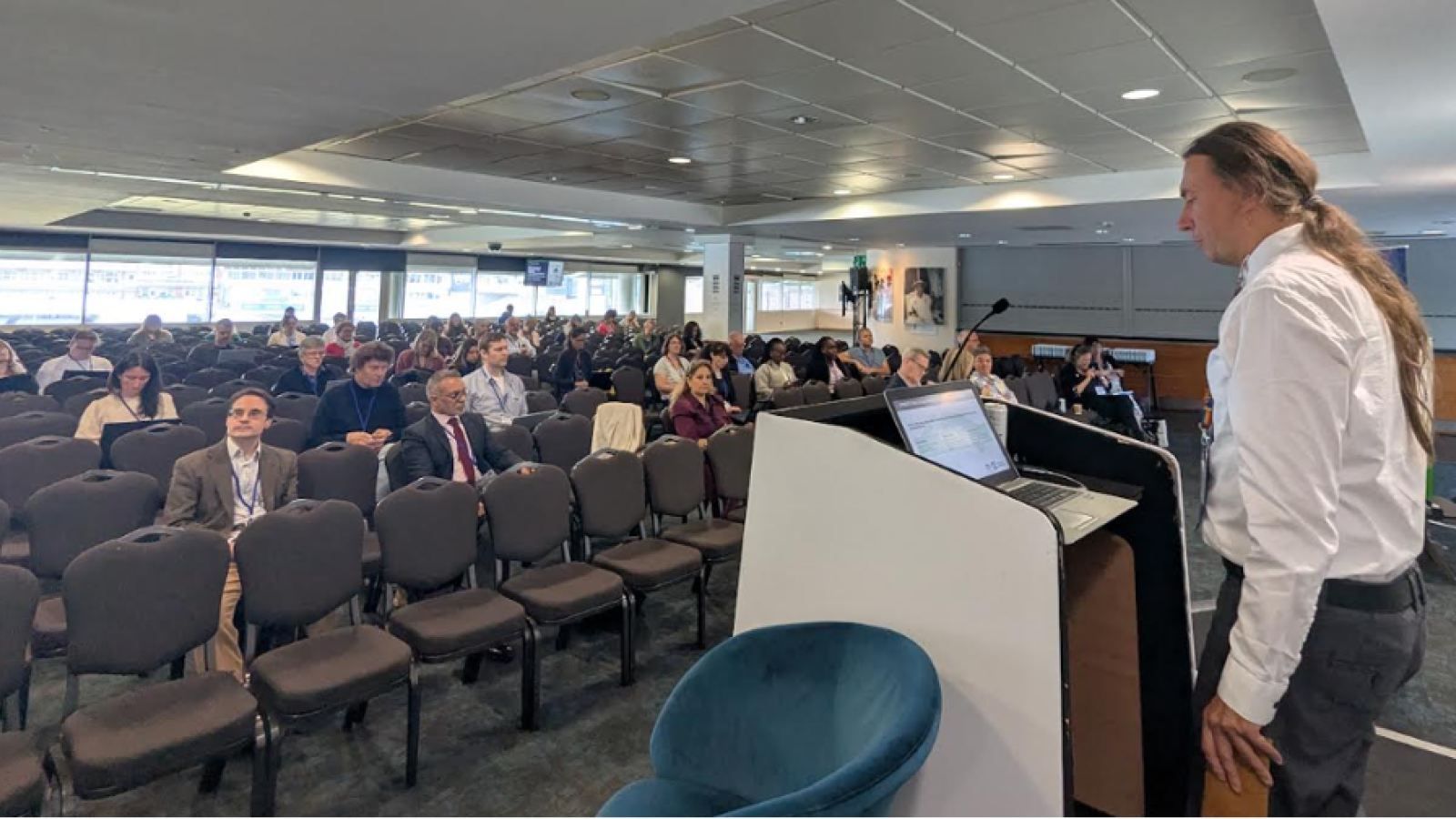
A Birds of a Feather session at the 27th RDA Plenary in London brought together around 60 participants to discuss whether a new RDA group could help connect fragmented approaches to Data Quality across disciplines and infrastructures. The response was clear: there is strong interest in continuing the work, with a first group of volunteers ready to help shape a future charter.
The session “Data Quality: Towards Cross-domain Harmonisation, Provenance-aware Approaches, Uncertainty Management and Interoperable Practices”, which took place on 6 October, was organised as a first community test, to see whether there is enough common ground and interest to develop a dedicated RDA group on Data Quality and the related processes needed to support it?
Data quality is essential for data reuse, interoperability and trust, but the ways in which quality is defined, assessed and communicated remain fragmented across disciplines, infrastructures and research communities. Provenance, uncertainty, metadata quality and data-management processes also influence whether data are fit for a particular purpose. These challenges become even more critical as heterogeneous datasets are aggregated across domains and increasingly consumed through automated and AI-supported processes.
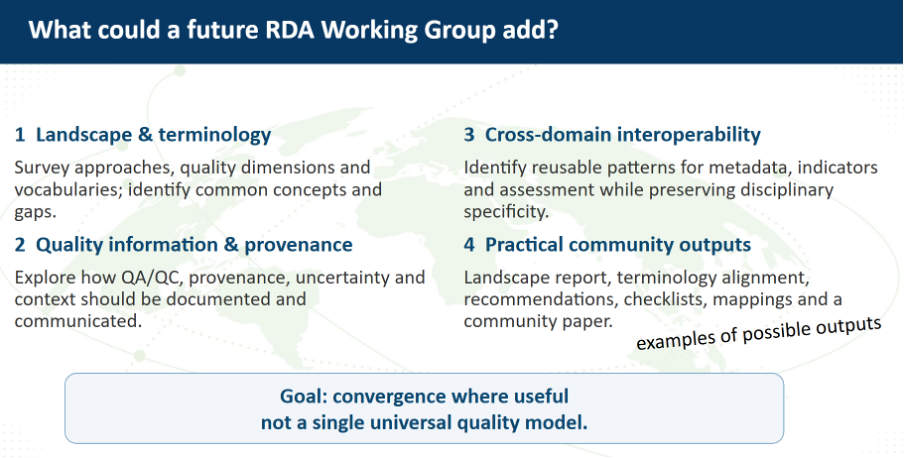
The objective is therefore not to create a single universal model for Data Quality, but to identify where convergence is useful while preserving the specificity required by individual research domains.
Building on existing initiatives
Rather than starting from scratch, the session brought together complementary work already underway.
Romain David (ERINHA) introduced the rationale for a possible RDA group and outlined four areas where cross-domain coordination could add value: mapping the existing landscape and terminology; improving how quality information, provenance and uncertainty are documented; identifying reusable patterns supporting cross-domain interoperability; and developing practical community outputs such as mappings, recommendations and checklists.
Kamil Dziubek presented work from the CODATA Task Group on Research Data Quality Management Across the Data Lifecycle, including its exploration of Data Quality Essential Variables (DQEVs). The approach seeks a small discipline-neutral core that could make quality information more comparable and machine-interpretable while allowing domain-specific extensions.
Simon Hodson presented related work from CDIF4EOSC, which is mapping and categorising existing quality frameworks and exploring a cross-domain profile for documenting data quality. The work highlights both the potential common ground around concepts such as accuracy and uncertainty, completeness, consistency, reliability, relevance and reproducibility, and the need to distinguish between different ways of expressing quality, including metrics and narrative quality reports.
Together, these contributions illustrated the opportunity for RDA to provide a neutral international space in which existing initiatives can be compared, connected and tested across disciplinary boundaries.
A strong signal from the community
The 40-minute session attracted around 60 participants in addition to the presenters, representing research infrastructures, universities, data centres, libraries and international initiatives from Europe and beyond.
When participants were asked whether there was enough common ground for a dedicated RDA group, at least 25 people immediately raised their hands. The subsequent sign-up showed broader interest, with around half of the participants expressing an interest in following or contributing to the initiative.
Importantly, the discussion moved beyond general support. Around eight to ten participants volunteered to contribute directly to the development of a future group charter, bringing perspectives from areas including Life Sciences, Earth and Space Sciences, Materials Science and Engineering, Environmental and Ocean data, research software and semantic interoperability.
This diversity is particularly important. One of the key principles emerging from the session was that cross-domain harmonisation should preserve rather than erase disciplinary quality practices.
What comes next?
The immediate next step will be to bring the interested community together for a longer follow-up meeting and begin defining the scope of the prospective RDA group. This will include clarifying the relationship between Data Quality and the processes that support it, identifying two or three priorities suitable for an initial charter, and connecting with relevant RDA groups and external initiatives.
Potential areas already identified include terminology and landscape mapping, provenance and uncertainty, machine-actionable quality information, cross-domain interoperability and practical guidance for research communities.
The BoF therefore achieved its main objective: testing whether a sufficiently broad community exists to take the discussion further. The strong participation and the number of volunteers suggest that it does.
The next challenge will be turning this interest into a focused scope and a realistic set of community outputs — building on existing work rather than duplicating it, and seeking convergence where it can genuinely improve the interoperability, reuse and trustworthiness of research data.
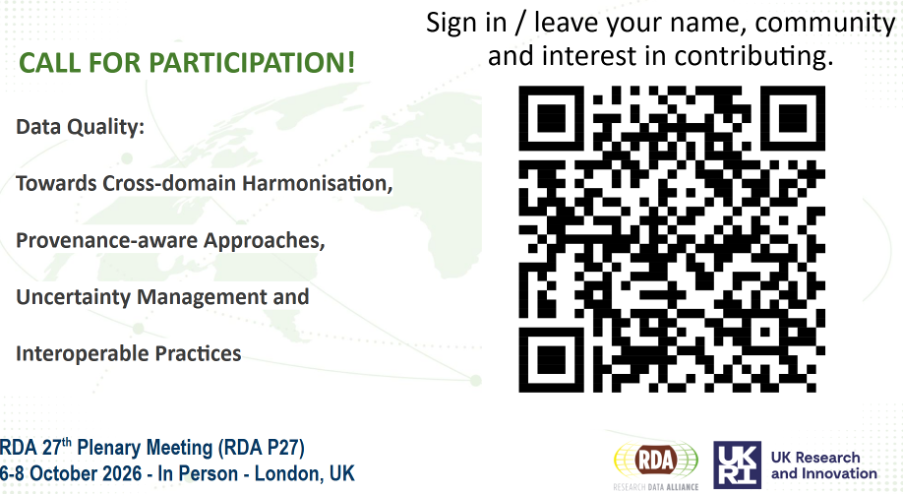
More information about the session:
Interested in the follow-up webinar?
If you would like to be informed about the upcoming webinar and the next steps towards the prospective RDA group, please contact romain.david@erinha.eu .